Food in The Media
Film and Book Reviews by Xan Nelson
(Photo from http://www.brunbabybrun.com/img/faceoff.jpg)
Film Review:
Super Size Me by Morgan Spurlock
Nominated for the Best Documentary
Oscar at the 2004 Academy Awards, Morgan Spurlock’s Supersize Me has
been hailed as one of the most clever, engaging and informative documentary
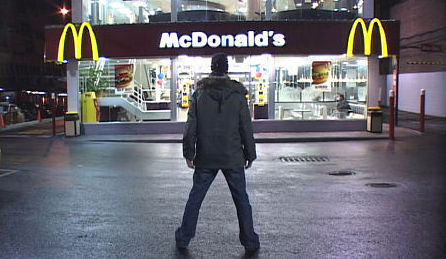
films of the year. Picture this: a healthy, virile, 32-year-old man decides
to embark on a 30-day experiment in which he will consume nothing but MacDonald’s
food, three full meals a day, seven days a week. When invited to “Super
Size,” he super sizes. And he must finish every bite of every meal.
Documenting the astounding results of this experiment in his award-winning
film, Spurlock examines such urgent issues as globalization, pervasive and
manipulative marketing strategies, corporate responsibility, and the obesity
crisis threatening Americans today.
In a recent lecture at Vassar College
in honor of Earth Week, Spurlock discussed his inspiration for the film. After
enjoying a Thanksgiving feast at his mother’s house in West Virginia,
he said, he was watching the news when he saw a feature about two girls who
decided to sue MacDonald’s for selling them food that made them obese.
Inspired by the implications of this lawsuit, Spurlock committed himself to
his project. What would happen, he wondered, if a person were to eat exclusively
MacDonald’s food for a solid month?
In his quest for the answer, Spurlock
visited MacDonald’s franchises in 20 cities, including Houston, the
reigning “fattest city in America.” He sampled each and every
offering on the MacDonald’s menu, and limited his diet to only those
foods available over the MacDonald’s counter (including beverages).
In a seamlessly edited production, his hilariously funny footage of his own
eating experiences are coupled with shocking, disturbing and sobering footage
of interviews with representatives from the corporation, public school food
service workers and gym teachers, devoted juvenile and adult MacDonald’s
consumers (“heavy users” and “super heavy users,”
as dubbed by the corporation itself), and the doctors and nutritionists who
stood by Spurlock to measure and document his rapidly deteriorating health.
With his compelling primary research,
indisputable evidence and sidesplitting commentary, Spurlock’s message
about the dangers of fast food consumption and the growing obesity epidemic
come through loud and clear. This film, winner of the Best Documentary Award
from the International Press Academy, the Best Director Award at the Sundance
Film Festival, and the Documentary Screenplay Award from the Writers Guild
of America, only recently released in 2004, has taken both the film and fast
food industries by storm. It is provocative and engaging, shedding light on
some of the most pressing issues in American and global health, and it is
sure to make you laugh, think, cringe, and maybe reconsider that next Big
Mac.
(Photo from http://www.worldhungeryear.org/amazon/images/fast.jpg)
Book Review:
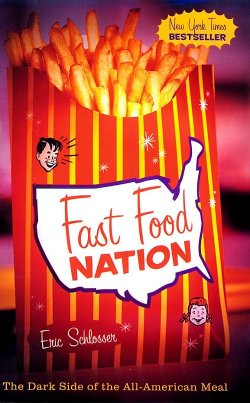
Fast Food Nation by Eric Schlosser
“Americans,” writes
Eric Schlosser, author of Fast Food Nation, in the shocking and riveting introduction
of his 2001 New York Times Bestseller, “now spend more money on fast
food than on higher education, personal computers, computer software, or new
cars. They spend more on fast food than on movies, books, magazines, newspapers,
videos, and recorded music—combined.” In the investigative tradition
of Upton Sinclair, armed with an astonishing breadth and depth of information,
a stylistic grace and a perceptive eye for irony that make for a fast, compelling
read, Schlosser launches a apt and thorough critique of America’s $110
billion fast food industry, exploitative production, consumerism and the nuances
of “the American way.”
That the fast food business is
one of the largest, most visible and most pervasive global industries in the
world can hardly be denied. From New York to Paris, St. Petersburg to Prague,
Santiago to Sao Paulo, Sydney to Beijing, corporations like MacDonald’s,
Burger King and KFC have opened franchises catering to the specific tastes
of their targeted populations. In this captivating expose revealing some of
the best-kept industry secrets, Schlosser asks questions ranging from how
do they make the food taste like that? to what exactly goes on behind the
veil of smiling cartoons and Happy Meals to manage and market this billion
dollar industry? to why do we, as a nation and as a global community, continue
to support corporations that threaten our health, our safety and the stability
of our food and farming systems? Schlosser digs deeply to access the truth
about topics including the wild success of carefully crafted marketing campaigns,
the disturbing ability of fast food companies to target children and hook
them as lifelong consumers, the callous treatment of franchise employees,
oppression of working-class and minority populations, the irresponsible and
hazardous management of the meat-packing industry, and the disturbing and
grotesque realities of a sci-fi food production system redolent of the Frankenstein
of the future.
Critics agree that Schlosser’s provocative first book is a fine work of muck-raking journalism. It is exhaustively researched, compellingly argued and thoroughly convincing. For any reader with an interest in corporate responsibility, globalization, workers’ rights, or even just why the fries taste so good, Fast Food Nation is recommended as one of the most accessible, interesting and informative contemporary social criticisms available.